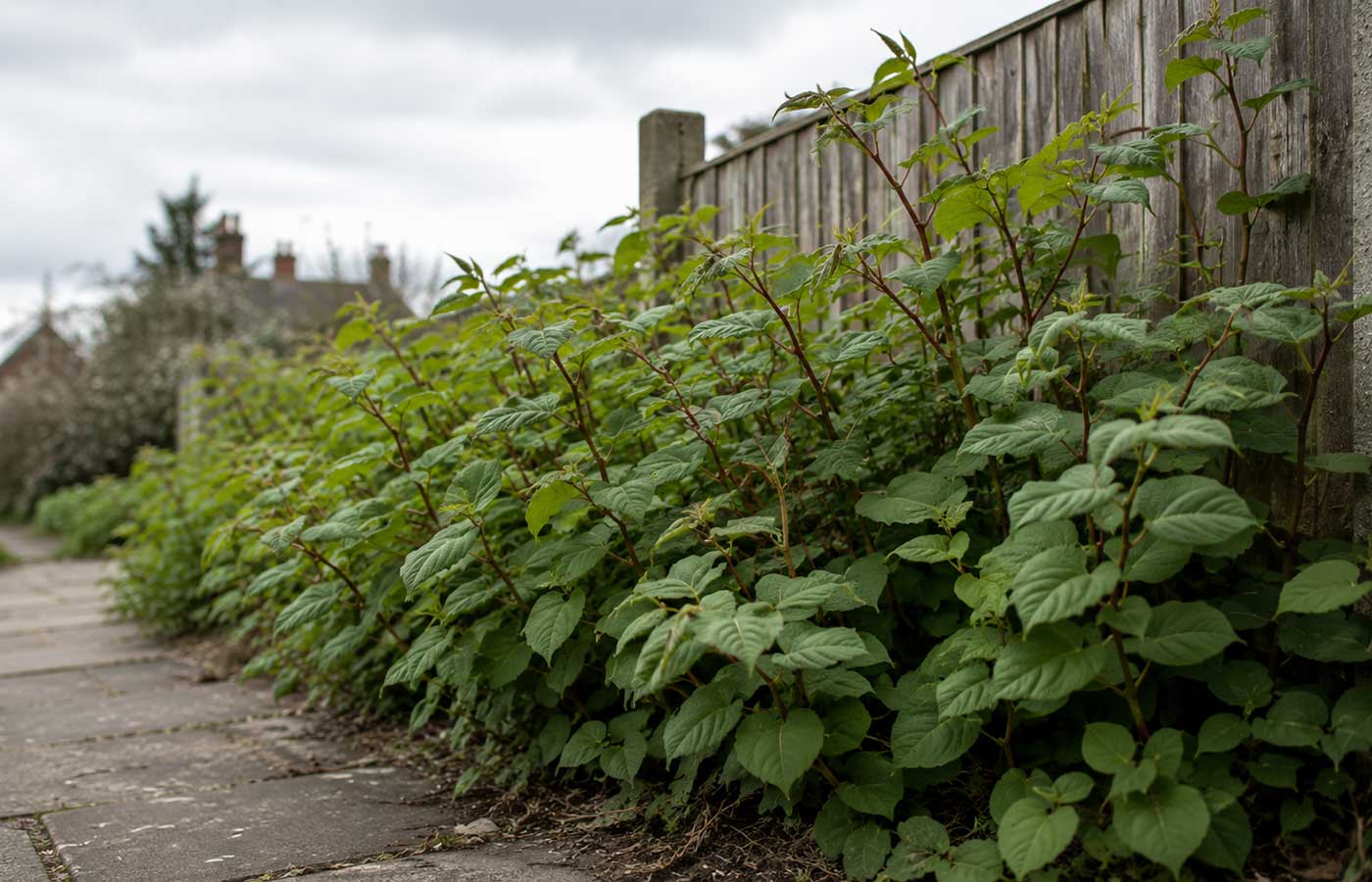
Concrete and paving are one of the biggest knotweed concerns
Many people become worried about Japanese knotweed after spotting suspicious growth emerging near concrete paths, driveways or patios.
Photographs of plants apparently forcing their way through hard surfaces are widely shared online and often create understandable concern for homeowners.
The situation can look alarming, particularly when fast-growing stems appear beside cracked paving or old concrete slabs.
Why knotweed becomes associated with concrete damage
Japanese knotweed is known for its extensive underground rhizome system and strong seasonal growth.
People often notice suspicious growth near:
- Garden paths
- Driveways
- Concrete patios
- Retaining walls
- Garage bases
- Steps and edging
When cracks or movement already exist in these areas, knotweed growth can appear especially dramatic.
The plant often exploits existing weaknesses
One important point is that suspicious growth commonly appears where surfaces are already damaged, uneven or vulnerable.
Older paving and concrete frequently contain:
- Small cracks
- Expansion joints
- Weak edges
- Drainage gaps
- Areas of previous movement
Fast-growing vegetation may then emerge through these weak points, making it appear as though the plant has broken directly through solid concrete.
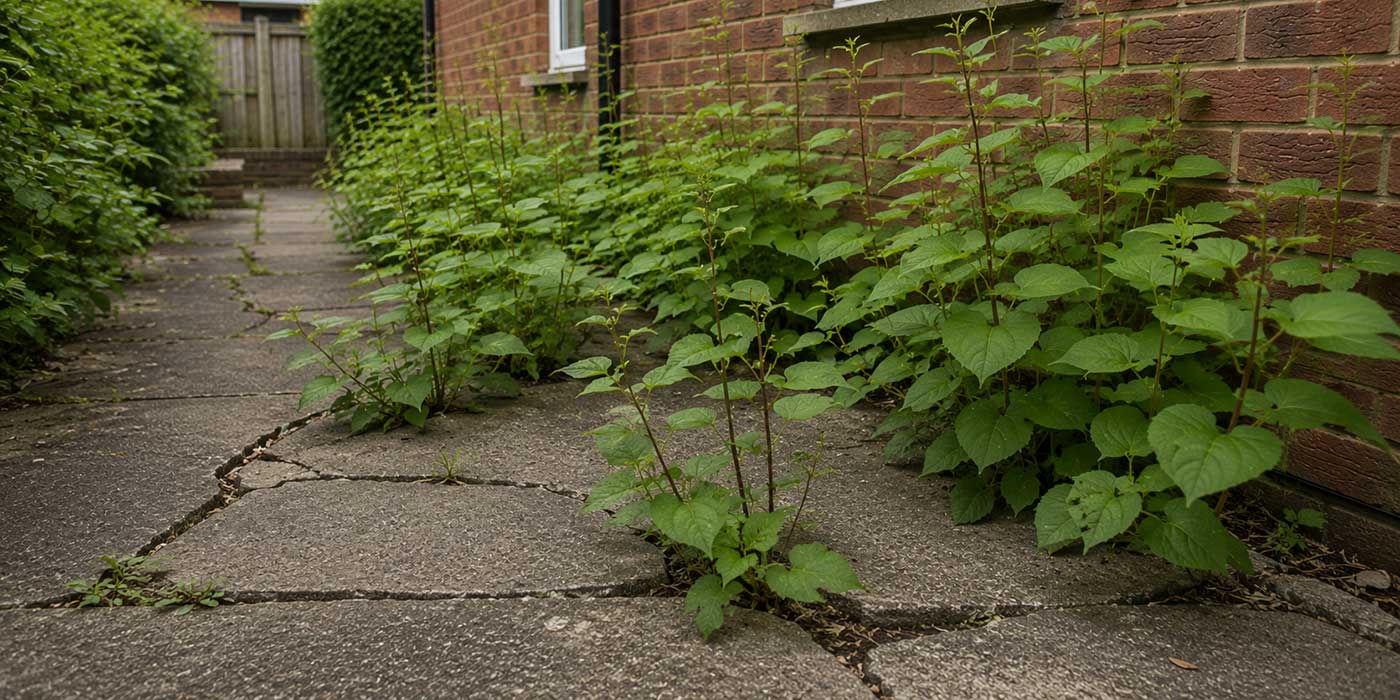
Growth beside paving is often what people notice first
In many gardens, knotweed first becomes obvious when stems emerge beside paths or hard landscaping during spring.
Young reddish shoots can appear surprisingly quickly once warmer weather arrives.
By summer, dense green growth may develop around paving edges, walls and boundary structures.
The speed of seasonal growth is one reason people become concerned so quickly.
Not every plant near concrete is knotweed
Many ordinary UK plants can also grow through cracks in paving and concrete.
Common examples include:
- Bamboo
- Bindweed
- Buddleia
- Weeds and self-seeded shrubs
- Tree saplings
- Fast-growing garden plants
Because of this, suspicious growth near hard surfaces does not automatically mean Japanese knotweed is present.
Older concrete often makes the problem appear worse
Cracked or ageing hard surfaces can make knotweed growth look particularly dramatic.
Loose slabs, uneven driveways and weathered concrete sometimes allow vegetation to emerge more easily than newer surfaces.
When dense green stems suddenly appear in these areas, homeowners often assume the plant must have forced its way through solid concrete itself.
People often become worried about nearby structures
Once suspicious growth appears near paving or concrete, attention often turns to surrounding structures as well.
Common concerns include:
- House walls
- Foundations
- Drainage areas
- Garage floors
- Retaining walls
- Boundary fences
Dense vegetation close to buildings understandably attracts caution and further investigation.
The time of year can change how growth appears
Japanese knotweed changes appearance significantly through the seasons.
Spring shoots emerging beside concrete often appear reddish and compact at first.
By summer, the plant may become tall and leafy, making the affected area appear heavily overgrown.
In winter, most visible growth dies back, leaving dry hollow canes behind.
Photographs often help assess suspicious growth
If unusual plants are appearing through paving or concrete, useful photographs usually include:
- The surrounding hard surface
- Any visible cracks or gaps
- The full plant
- Leaves and stems together
- The nearby structures
- The wider garden area
Wide photographs showing the whole setting are normally more useful than isolated close-up images.
Boundary areas commonly attract attention
Suspicious growth often appears along the edges of paths, fences and neighbouring properties where surfaces naturally contain joints and gaps.
People may become particularly concerned if vegetation appears:
- Beside shared driveways
- Near retaining walls
- Along narrow paths
- Close to extensions or garages
The combination of dense growth and visible cracking often increases anxiety.
Many concerns begin with uncertainty
For many homeowners, the biggest issue is simply not knowing whether the plant is actually Japanese knotweed.
Fast-growing vegetation emerging near hard surfaces naturally attracts attention, particularly after reading alarming online stories.
Careful comparison of stems, leaves and overall growth patterns usually provides a clearer picture than relying on location alone.
Related pages
Trying to rule out knotweed?
A clear picture may help determine whether a plant resembles Japanese knotweed.